


A thousand dollars is the point where digital pianos stop making excuses. Below it you accept a compromise somewhere; at this level you can reasonably expect a graded hammer action, a full 88-key range, a proper pedal input and speakers that fill a room without distorting. What you cannot expect is that every instrument at this price delivers all four.
The differences between models in this bracket are not about specifications on the box, which are increasingly similar, but about which detail each manufacturer chose to spend the money on.
The action in this price bracket
Most instruments around a thousand dollars use a graded hammer action with three sensors per key. The practical difference between a good one and a mediocre one is the pivot length: a longer key pivot means the force required at the front and the back of the key is closer, which feels more like an acoustic and makes playing near the fallboard possible.
Short-pivot actions feel fine in the middle of the key and awkward at the edges. Since real repertoire uses the whole key, this is worth testing specifically: play a scale with your fingers close to the black keys and see whether control collapses.
Sound engines and how they behave
At this price you get either a sampled engine with multiple velocity layers or a modelled engine. Sampled pianos sound convincing at moderate volumes and can sound slightly static when played very quietly, where the layers become audible as steps. Modelled engines respond continuously but can sound synthetic in the mid range.
Both are legitimate. What matters more is sympathetic resonance, the behaviour of the strings you are not playing when the pedal is down. Without it, sustained chords sound thin and the instrument feels less alive than an acoustic.
Speakers, amplification and headphones
Cabinet instruments at this price usually have two speakers facing down or forward, with a small amplifier. They sound acceptable in a small room and thin in a large one. If the room is big, plan for an external amplifier or buy a stage piano and a speaker instead.
The headphone output is the specification nobody advertises and everybody uses. A noisy output at low volume is a genuine annoyance in a flat at night, and it is one of the few things you can test in a shop with your own headphones.
Pedals and the cabinet
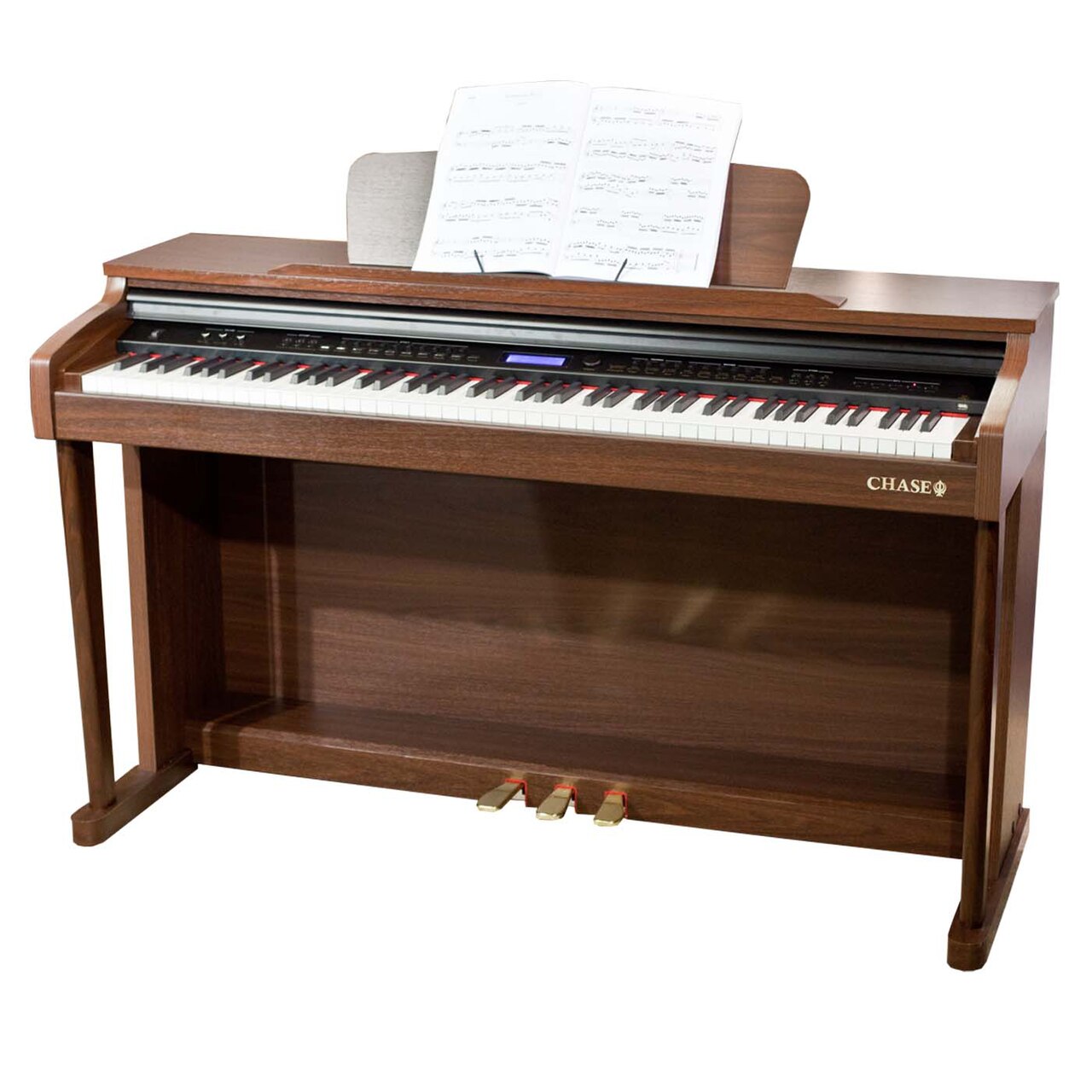
Better instruments in this bracket include a three-pedal unit mounted in the cabinet, with continuous detection on the sustain pedal. That is worth having if you play anything from the nineteenth century onward. A sliding switch pedal is a downgrade that is easy to miss when comparing listings.
The cabinet itself matters more than it sounds. A stable cabinet with a proper music rest and a bench at the right height changes how long you practise, and a wobbly one makes a good action feel worse.
What to skip at this price
Skip built-in rhythms, hundreds of voices and arranger features. They date quickly and add cost that would be better spent on the action. Skip Bluetooth audio if it comes at the expense of a proper line output.
Do not skip the bench. A wrong-height bench is the most common cause of tension in beginners, and it is cheaper to fix than any other part of the setup.
Buying used in this bracket
A five-year-old instrument that originally cost twice as much is usually a better purchase than a new one at the same price, provided the action is sound and the pedals work. Test every key, test the pedal continuously rather than as a switch, and check that the cabinet has no water damage at the base.
If you want a shortlist rather than reading every listing, this best digital piano under 1000 roundup is a reasonable place to start, as long as you check the action type and pedal arrangement for each model yourself.
Where the money goes in this bracket
Three manufacturers dominate, and each spends the budget differently. One puts money into the action and saves on speakers; another puts money into the sound engine and saves on the cabinet; a third builds a solid cabinet and uses a simpler engine. None is wrong, and the right choice depends on whether you mostly play through headphones, in a small room, or with other musicians.
If you play with headphones most of the time, buy the best action you can afford and ignore the speakers entirely. If you play for a room, speakers and cabinet matter more than the last increment of touch response.
The amplifier question
A digital piano rated at eight watts per channel is audible in a living room and lost in a hall. If you accompany singers or play in a group, a stage piano plus an amplifier is the more honest purchase than a cabinet instrument pushed to its limit.
Connectivity that actually gets used
A USB MIDI port is the one connection worth insisting on, because it lets the instrument drive a computer or tablet later. Bluetooth MIDI is convenient and occasionally unreliable; a cable is not. Line inputs and outputs are useful; built-in rhythm sections are not.