






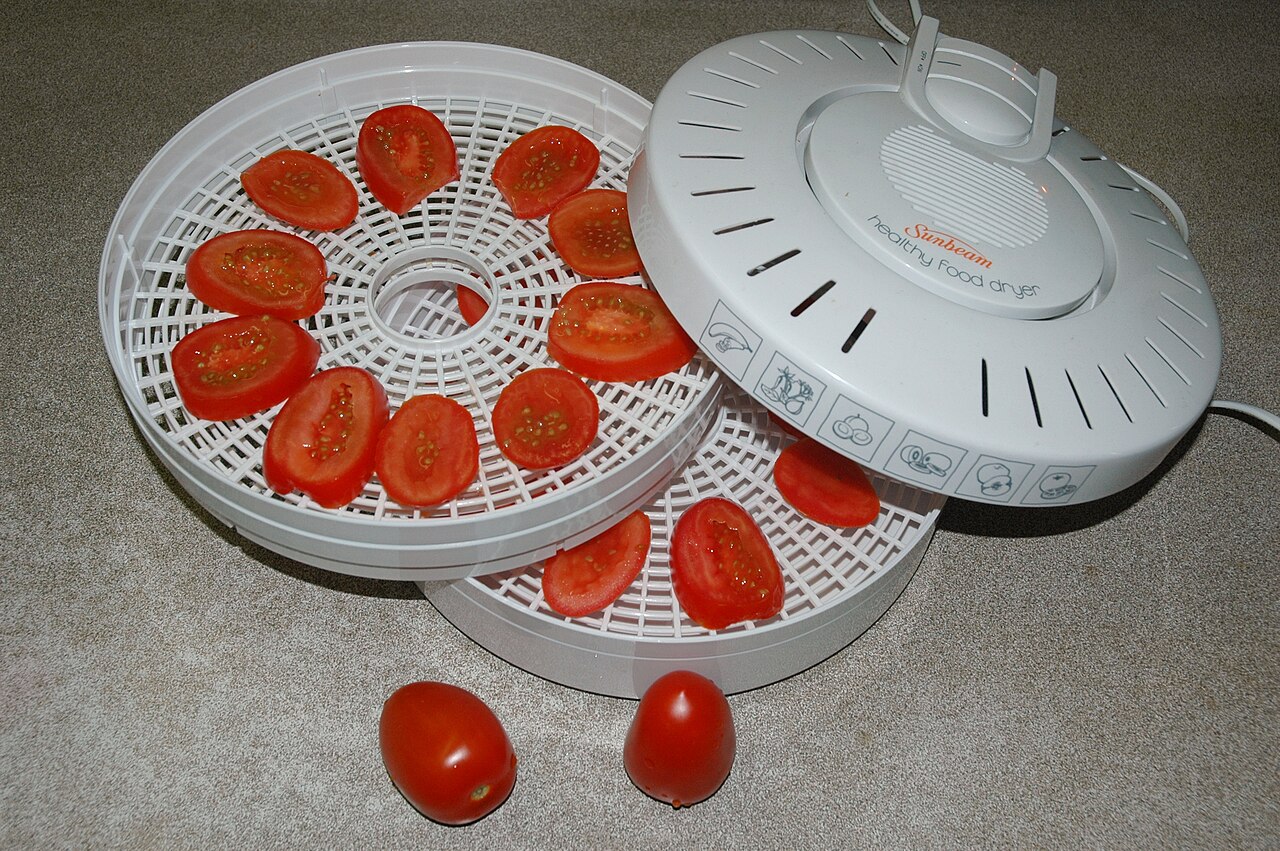
Food dehydrators are sold mostly on tray count and price, and the material of the trays is treated as a detail. In practice, tray material decides how long the machine lasts, how evenly food dries and whether you can wash it without thinking about it.
Stainless steel trays and plastic trays cost differently, behave differently and fail differently. Here is what actually changes when you choose one over the other.
Heat, warping and long sessions
A dehydrator runs for eight to twenty hours at a time, often unattended. Plastic trays at 65 to 70 degrees Celsius are working near the upper end of what many food-grade plastics tolerate comfortably, and repeated cycles cause warping around the rim. A warped tray does not sit flat, so air bypasses the food and drying becomes uneven.
Stainless steel trays do not warp at any temperature a domestic dehydrator can produce. That single fact explains most of the longevity difference between the two.
Cleaning and staining
Stainless steel can be scrubbed, soaked and put in a dishwasher. Sticky residues from fruit leather or marinated jerky come off with a brush and hot water. Plastic trays scratch, and once scratched they hold residue and colour, which is why a two-year-old plastic tray looks permanently dirty even when it is clean.
Scratches also harbour bacteria in a way smooth steel does not. If you dry meat, that matters.
Mesh versus solid sheets
Most stainless machines come with mesh trays for small items and solid sheets for fruit leather and wet mixtures. Plastic machines often use a single moulded tray with slots, which limits what you can dry without adding liners.
Mesh is better for airflow and for small pieces that would fall through a slot. Solid sheets are essential for purees. A machine that offers both is more useful than one that offers only slots.
Airflow and tray spacing
Tray material affects airflow only indirectly, through flatness. What matters far more is whether the fan moves air horizontally across every tray or vertically through a central column. Horizontal airflow dries more evenly, especially on a full load, and it is the feature worth paying for before tray material.
Tray spacing is the second factor. Trays that sit close together dry the bottom of the load slowly, which is how people end up with case-hardened jerky that is dry outside and damp inside.
Weight, capacity and storage
Stainless trays weigh more, and a six-tray steel machine is heavy enough that lifting it onto a worktop is a two-handed job. Plastic machines are lighter and easier to move, which matters in a small kitchen where the dehydrator lives in a cupboard between uses.
That is the honest argument for plastic: portability and price. If the machine will be stored away and used occasionally, plastic is easier to live with.
Cost over the life of the machine
A steel machine costs more up front, sometimes twice as much. Over ten years of regular use, that difference disappears: plastic trays are often not sold as spares, so a warped tray effectively ends the machine’s life, while steel trays last as long as the heater.
If you dry a few batches a year, plastic is fine and cheaper. If you dry regularly, steel is the cheaper machine over its lifetime.
What to check before buying either
Check that the thermostat goes low enough. Many cheap machines start at 50 degrees Celsius, which is too hot for herbs and for proofing dough, and too imprecise for jerky. A machine with a 35 to 70 degree range is far more useful.
Check that trays are available as spares, and check the noise level. A dehydrator runs all night in some households, and a loud fan in a kitchen is a reason to stop using it.
If you want a starting point rather than reading every listing, this best stainless steel food dehydrator roundup is useful mainly for comparing tray counts against actual usable drying area.
What stainless does not fix
A steel tray does not make a badly designed machine good. Uneven airflow, a thermostat that swings twenty degrees and a fan that is louder than a kettle all remain problems regardless of tray material. Buy the airflow first and the trays second.
Cleaning routine that keeps either material usable
Soak trays for ten minutes before scrubbing, use a soft brush rather than steel wool, and dry them fully before stacking. Stacking damp trays is how a smell develops that no amount of washing removes.
Noise, and why it matters more than tray material
A dehydrator runs for most of a day, sometimes overnight. Fan noise that sounds acceptable in a showroom becomes the reason a machine stops being used in a small flat. If the machine is going in a kitchen that adjoins a living room, listen to it before buying or accept that it will only run during the day.
Where the machine will live
A steel unit is heavier and usually stays on a worktop, where it earns its space by being ready to use. A plastic unit tends to live in a cupboard, which means it gets used less often but takes no space. Neither arrangement is wrong; they suit different kitchens, and the decision is as much about storage as about drying.
The thermostat decides usability
Herbs want 35 to 40 degrees Celsius, vegetables around 50 to 55, jerky at 65 to 70. A machine that starts at 50 cannot dry herbs properly, and one that overshoots by ten degrees will case-harden meat. Check the range and the stated accuracy before the tray material.
What the fan design tells you
A rear-mounted fan pushing air horizontally across the trays is the design that dries most evenly. A top-mounted fan blowing down through a central column is cheaper to build and dries the middle trays faster than the edges. On a full load the difference is several hours and a visibly uneven result.
If the machine has no airflow diagram at all, assume a central column. That is not a reason to reject it, only to rotate trays more often and load fewer of them.
Spare parts and the end of the machine’s life
The parts that fail are the fan, the thermostat and the trays, in that order. Fan and thermostat failures usually mean replacement; tray failures only matter if spares are unavailable. Before buying, check whether trays are sold separately, because a machine whose trays cannot be replaced has a fixed life determined by the plastic rather than the heater.
How many trays is enough
Five or six trays covers a family’s typical batch of fruit or a kilogram of jerky. Nine-tray machines look generous and are usually run half empty, which is the least efficient way to use one. Buy trays to match your batch size rather than your cupboard.