


A floor reading lamp is the answer to a problem desk lamps cannot solve: you want light on a book or a chair, not on a desk, and you do not want to give up the table space or run a cable across the room. In a small flat, that difference matters more than the lamp itself.
The trade-off is that floor lamps are harder to position than desk lamps. A tall lamp in the wrong corner lights the ceiling; a short one lights your knees. Getting the geometry right before you buy is most of the decision.
Height and reach: the two numbers that matter
For reading in a chair, the shade should sit roughly at eye level when you are seated, with the bottom of the shade a little below your line of sight. That usually means a lamp between 150 and 170 centimetres tall, with a head that can be angled down and forward.
Reach matters as much as height. A lamp whose head cannot lean over the chair will light the wall behind you, which looks warm and does nothing for the page. Look for an arm of at least forty centimetres, or a head that tilts through a wide arc.
Footprint in a small room
A weighted round base is stable but takes up floor space and is easy to kick. A slim base or a tripod spreads the load without a large disc, and a lamp that sits behind the chair rather than beside it keeps the walkway clear.
If the room is really tight, consider a clamp-mounted lamp on a shelf edge or a wall-mounted swing arm instead. Both remove the floor footprint entirely, and both are often cheaper than a decent floor lamp.
Light quality: what to insist on
For reading, aim for 400 to 700 lumens at the page, dimmable to well below that for evening use. A lamp with a fixed high output is tiring; one that dims to a warm low level gets used far more often.
Colour temperature around 2700K to 3000K suits a living room and keeps the page readable without the clinical feel of daylight bulbs. If the lamp takes a standard bulb, choose a high colour rendering index bulb, ideally 90 or above, so print and fabric colours look right.
Check for flicker. Cheap drivers flicker at twice the mains frequency, which is invisible to most people and tiring over an evening. Pointing a phone camera at the shade is a quick test: strong banding on the screen is a warning sign.
Shade design and glare
A shade that directs light down and slightly back works better than one that throws it in all directions. Opaque shades with a reflective inner surface concentrate light on the page; fabric shades soften it and light the room, which is pleasant for atmosphere and poor for reading.
If you read for long stretches, avoid a bare bulb or a clear shade. Both put a bright source in your field of view, which is exactly what causes the squinting that people blame on the book.
Stability, switches and cables
A floor lamp gets knocked. Check that the base is heavy enough not to tip when the arm is extended, and that the joints hold position rather than slowly drooping over an evening.
The switch should be reachable from a seated position, ideally a foot switch on the cable or a touch control on the stem. A switch halfway down a lamp behind a chair is the reason people leave lamps on all night.
Cable length is the most overlooked detail in small rooms. Measure from the socket to the corner before buying, and if the cable is short, plan for an extension rather than discovering it after delivery.
Reading in bed versus reading in a chair
In a chair, a floor lamp behind and to the side of the shoulder works well: the light falls across the page and your body blocks it from your eyes. In bed, a floor lamp needs to sit behind the headboard or beside the bed with the head angled down, otherwise it shines straight into your face.
If the same lamp has to do both jobs, prioritise the chair and add a small clip-on light for the bed. One lamp that does both badly is worse than two that each do one thing well.
What to compare before buying
Compare height, arm reach, whether the head tilts and locks, the maximum wattage or lumen output, and whether the switch is reachable. Ignore the styled photographs: almost all of them are lit by equipment that is not in the frame.
If you want a shortlist rather than reading every listing, this best floor reading lamp guide covers the shapes that work in small rooms, and it is worth checking each option against your own chair height before ordering.
Living with one lamp in one room
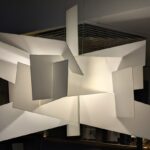
The most common regret after buying a floor lamp is buying it for looks. A slim sculptural lamp that throws light upward is a lovely object and a poor reading light, and in a small room there is no second lamp to compensate.
The second most common regret is size. A lamp that looked proportionate in a showroom with three-metre ceilings can dominate a room with a 2.4-metre ceiling, and a shade that sits above eye level when you are seated will light the wall rather than the page.
Measure the chair, not the room. Sit in the chair you actually read in, note where your eyes are, and check that the shade bottom lands a little below that line with the head angled toward the page. If it does not, the lamp is the wrong shape regardless of how good it looks.
Bulbs, warmth and running cost
An LED bulb at 2700K and around 800 lumens draws under ten watts, so a reading lamp used three hours a night costs very little to run. Spend the money on a high colour rendering bulb rather than on a brighter one: the difference in how print and paper look is immediately obvious, while extra brightness mostly adds glare.


